
As this year’s Tour de France charges through the high mountains and flatlands of France, the story isn’t just about who’s wearing the yellow jersey, it’s about how we’re watching.
From AI-driven race analysis and live rider telemetry to Warner Bros. Discovery’s new quad-screen viewer and private 5G networks capturing every surge and sprint, the Tour has become one of the most technologically advanced sporting spectacles in the world.
This year also saw the launch of the official Tour de France 2025 video game, allowing fans to race the same stages virtually and rank themselves alongside the real riders. It’s a remarkable feat of digital engagement, bringing the race beyond television and into living rooms, mobile devices and gaming consoles.
And it raises an increasingly urgent question for those of us in paddle sports: if other sports can do this, why not us?
As the founder of Paddle Games, I’ve been asking this question for some time. In fact, I’ve long wanted to develop a virtual racing experience for canoe sprint, where fans and aspiring athletes could compete on digital replicas of real courses, measure their performance against elite paddlers, and experience the tactical intensity of the sport in an interactive format.
We explored the idea last year, but the reality is that building something like this requires significant investment, not only in development but in the surrounding infrastructure: data capture, visualisation tools, and a shared digital framework.
Still, the ambition remains. And in similar ways, the change has already begun.
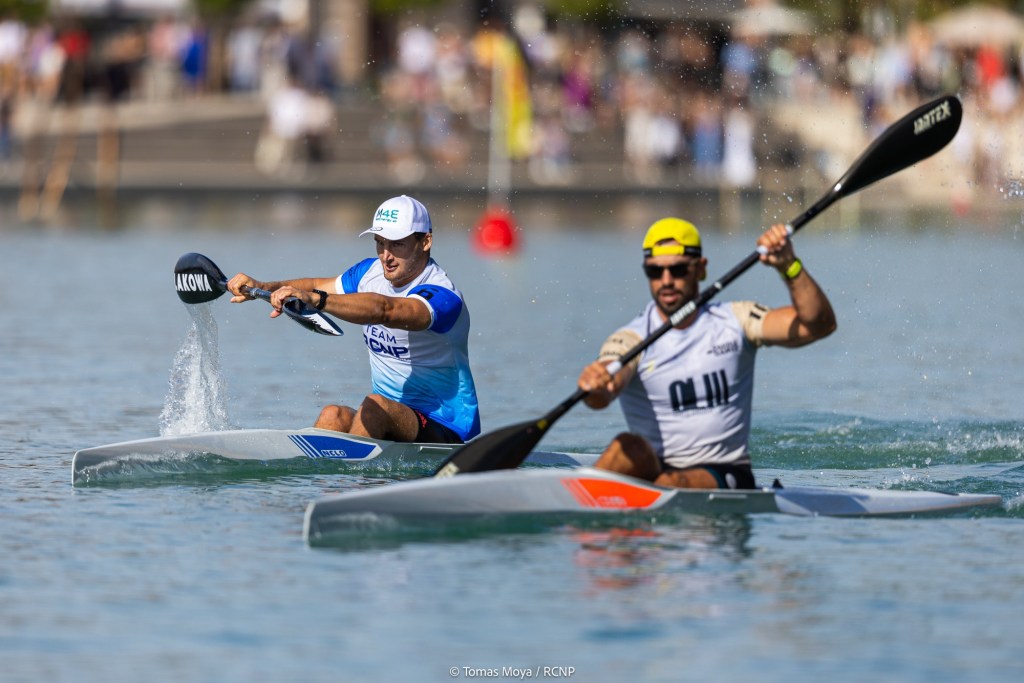
At this year’s Canoe Sprint and Canoe Marathon European Championships, we saw the early signs of what a tech-enhanced future could look like. Thanks to the collaboration between the European Canoe Association (ECA) and technology partner Memosoft, the events featured meaningful innovations, from improved live data streams to enhanced visual overlays.
This kind of openness is exactly what the sport needs. It’s proof that there’s a growing willingness at the organisational level to bring canoeing into the digital era.
Now the next step is to make that data useful, accessible, and engaging, not just for coaches and athletes, but for fans too.
The Tour de France’s success in this space is about more than gadgets and dashboards. It’s about making the hidden layers of elite sport visible to everyone.
Just as cycling fans now track cadence, power output, wind resistance and gradient in real time, there’s enormous potential to do the same in canoe sprint with:
Live Stroke Rate – Visualised in real time, this could help fans understand changes in pace or fatigue levels across the race. Speed and
Acceleration Profiles – Who had the fastest start? Who closed best over the final 100 metres? These dynamics are often invisible to the naked eye but could be surfaced through simple graphics.
Tactical Visualisations – Much like VeloViewer for cycling, we could map out split times, lane differences and mid-race surges, revealing the strategy behind the race.
Comparative Tools – Allowing fans (and athletes) to compare their performance to Olympic champions or track improvements over time, bringing gamification and personal benchmarking into the picture.
Data shouldn’t make sport colder. It should make it deeper. The goal is not to turn canoe sprint into a spreadsheet, but to bring fans closer to the action, to help them understand why one athlete surges at a specific part of the race, or why another’s rhythm collapses in the final stretch.
At Paddle Games, we’re already exploring this space: breaking down race strategies, sharing insights, and looking at how we can tell better stories through numbers. But we know there’s more to be done.
We don’t just want people to watch canoeing. We want them to feel it—to track it, game it, simulate it, and immerse themselves in it. Whether it’s a parent supporting a young athlete or a fan watching their first World Cup final, the tools are there to make the sport more accessible, more interactive, and more thrilling.
The Time is Now
Cycling didn’t become a tech-forward sport overnight. It took partnerships, open minds, and an understanding that the future of sport isn’t just about athletes. It’s about how we share their stories.
With the ECA already moving in the right direction, with partners like Memosoft supporting innovation, and with franchises like Paddle Games pushing the vision forward, canoe sprint is on the cusp of something transformational.
The technology exists. The appetite is growing. Now it’s about aligning ambition with action, and bringing the same digital excitement that surrounds the Champs-Élysées to the finish lines of exciting paddling places like Palma de Mallorca, Copenhagen, Manchester or Sydney.
Because in sport, as in paddling, direction matters. And the current is pulling us forward.
 REINVENT THE GAME.
Leave a comment